

Stop selling services, start solving needs

I remember reading a story on the internet (so it’s probably not true) about a guy who interviewed for a job. It was some sort of sales position. And the company handed him a laptop and asked him to sell it back to them.
Suddenly, the man jumped up, grabbed the laptop, and darted out the door.
Sat smugly at home an hour later, the company called him up and asked if he could return the laptop.
“$500 and it’s yours,” he replied with a devilish grin I imagine looked a little like Jack Nicholson in The Shining.

Regardless of whether that actually happened, I think we can all see the lesson there… Namely, that if you want somebody to buy something from you, you have to make sure they actually need it.
In the interview room, the employer didn’t “need” the laptop. It was already there in their possession. And so any attempt to sell it to them would be met with resistance. But by engineering a scenario in which the employed actually did need the laptop, it became a whole lot easier to sell.
Cool story bro. What’s that got to do with me?
I’ve spent over five years working with agencies and consultants on positioning, messaging, and now their offer creation. Which means I’ve seen a LOT of agency websites. Way over 100 in fact.
And the common mistake that virtually all of them make?
They dive straight into explaining what they do. They just provide this long laundry list of services and offers and products and it all goes over a buyer’s head. Because what they haven’t done is what they guy in that story implicitly knew they should:
They haven’t engineered the need.
Now, I’m not for one minute suggesting that you should steal something from a potential client in order to sell it back to them. Not only is that wildly impractical but it also probably ends in you going to court.
Bringing a whole new meaning to “courting a client”.
But what you can do is clearly outline the context around your offer. It’s one thing to neatly package up what you do so it’s easier to buy. It’s a whole other thing to explain why potential clients actually need it.
Hm I see. How do I provide that context?
Well luckily I have a framework for that…
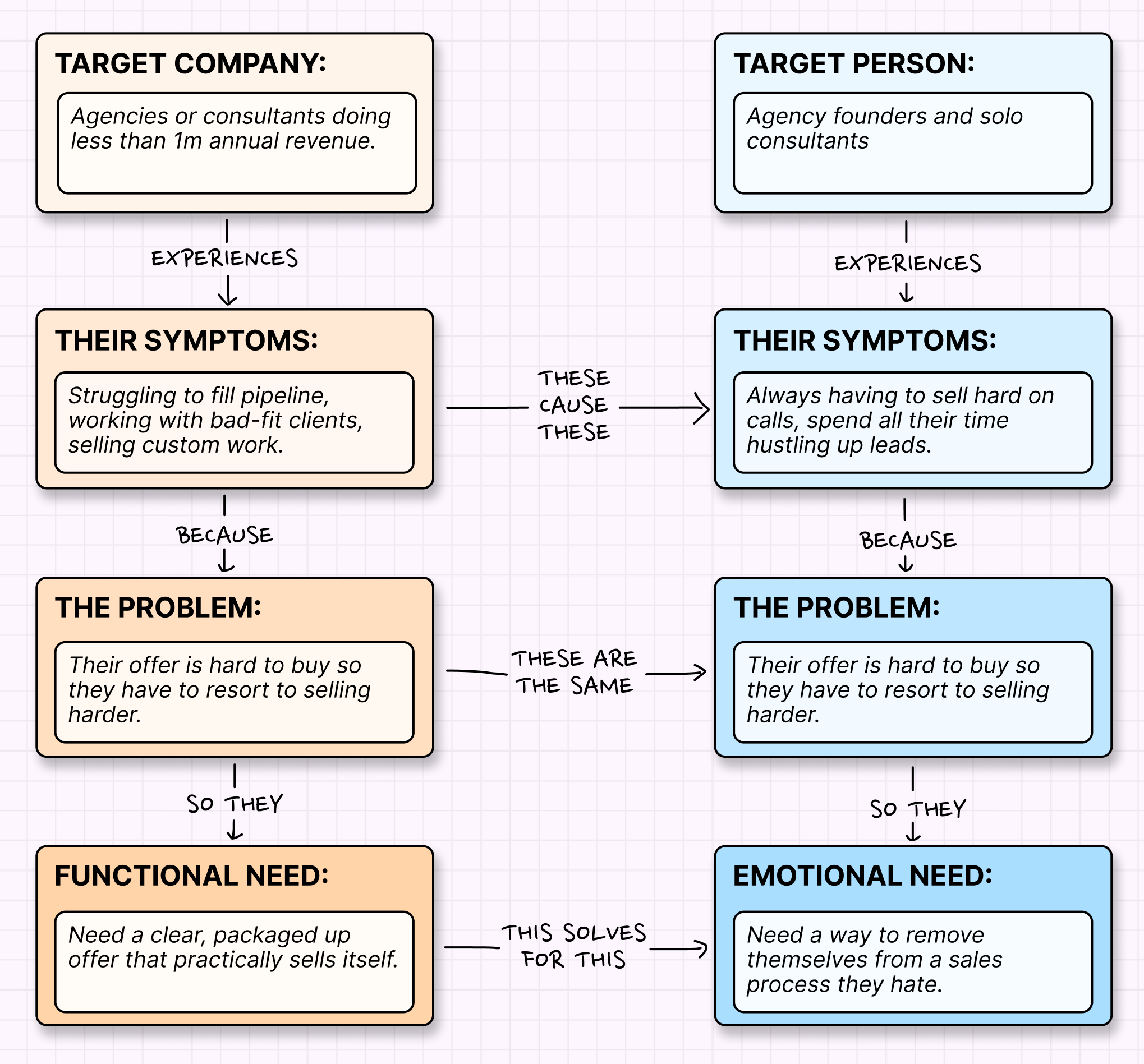
There are two main things to notice about this framework:
1 - There are two sets of needs, a functional one and an emotional one. (I’ll get to that later.)
2 - There is a clear four-step sequence that starts with the buyer and joins the dots towards what they actually need.
I’ll say it again because it’s important: STARTS WITH THE BUYER.
Most agencies and consultants approach this kind of work by reverse-engineering what they already offer. And that doesn’t work. I mean sure there’s an outside chance that you already accidentally built your offer around a specific set of needs. But more likely you built the offer because you wanted to sell a certain service.
So this exercise relies on you being clear on who you’re best suited to help. If you don’t know that yet, then I’d recommend going and figuring that out first.
But once you do know that, you need to put yourself in their shoes and ask yourself:
What symptoms are they facing?
If you were to jump straight into the diagnosis of a problem, you’d probably confuse and lose your buyers. Because they aren’t the subject-matter experts. You are. And so while it might be obvious to you that your target clients have a certain problem, it’s not always obvious to them.
In the diagram above I’ve included an example for my own consulting business. If I jumped straight to the problem and said “your offer’s hard to buy” then maybe some people would get it. But a lot probably wouldn’t. Because they hadn’t yet realised that was their problem.
Instead, it makes more sense to start with the symptoms. These are things that your buyer is actually facing and trying to deal with. Good symptoms are tangible, they’re measurable, or they can be acutely felt.
They’re also specific. It might be true that a symptom is “we’re not growing fast enough” but that could be caused by any number of things. Instead you should look a level deeper at specific obstacles that they’re facing.
Then you can ask yourself:
What’s the root problem?
Much like a doctor uses symptoms to diagnose an illness, your job is to take those symptoms and show potential buyers how those symptoms are actually causes by an underlying problem.
You outline the symptoms first to build rapport and show you understand their situation. It also acts as a good way of filtering out bad-fit clients. If they don’t have the symptoms they aren’t ready to buy your solution.
This root problem should then become your total obsession. I’ve written before about picking a problem and how it’s arguably the most important decision to make when it comes to packaging up and creating your offer.
And once you pick your problem, ask yourself:
What’s the actual need?
And so we reach the end goal… establishing the need.
Now logically speaking, once a buyer understands and acknowledges the problem, it stands to reason that their need is to solve that problem.
But that feels a little too simplistic in my opinion.
And so when I do this with clients, I encourage them to reframe the need as: “What does your buyer need to do or have in order to solve that problem?”
In my example, the problem is “the offer is hard to buy” and so what they need is “an offer that practically sells itself”.
If I can convince the buyer that’s what they need, then (and ONLY then) I can start to explain exactly how I can help them fulfil that need.
Right, but what about the two different needs?
Okay, so when you’re an agency or consultant chances are you’re selling a B2B offer. And a B2B offer is interesting because it’s aimed at two different target clients: the company and the individual at that company.
Now in some cases they’re the same. For example, I work with solo consultants. So they’re both the company and the individual. But it still helps to separate them as an business entity and person for reason I’ll outline now.
Businesses have functional needs
A business, by definition, can’t feel anything. The people in the business can, but the business itself is really just a legal entity. It’s a concept.
But businesses do have needs. Above all, they need to grow (or at least survive). And beneath that is a load of specific needs all geared around ultimately helping them grow.
Things like:
Improving their conversion rate
Reducing time spent on internal tasks
Ranking higher on search
You get the idea.
Agencies and consultants are usually pretty good at talking about these needs. But this is just the surface layer. Because underneath the business needs is a person.
And…
People have emotional needs
This is patently obvious when you actually think about it. Like of course people have emotional needs. But most agencies and consultants ignore the emotional needs of the buyer. And that’s a shame because they’re often the real, hidden driver of purchase decisions.
To refer back to my example above, the businesses I work with usually have trouble convincing clients to sign the dotted line and work with them. The underlying problem is that their offer isn’t buyable. And so they need an offer that sells itself. This is all totally functional.
I could just focus on that, and it might work relatively well. But instead I tap into the emotional need of the founder of those businesses: That they HATE selling.
They do it because they have to, not because they want to. And what they really need on an emotional and human level is to remove themselves from a sales process they hate doing.
This is far more powerful.
But there’s something else to consider:
The two needs are connected
As you can see from the diagram all the way up there (if you can be bothered scrolling) there’s a through-line between the functional need and emotional need.
Solving the functional need will help solve the emotional need. And vice-versa.
This is an important thing to realise because far too often these two needs are treated as separate things. And that’s why makes buyers uncertain.
Because they either just see the business case but aren’t emotionally invested. Or they’re emotionally invested but can’t justify the business case.
Your job is to show buyers how those two things are actually connected. That working with you is going to satisfy BOTH the functional and emotional needs. Because if you can do that then you’re speaking to them on a personal level and a rational, logical level.
Both needs are needed to make that purchase decision a no-brainer.
Phew okay. You’ve reached the end. Hopefully you’ve learnt a few things:
1 - That jumping straight into what you do isn’t useful if buyers lack the context.
2 - That the context is provided by starting with symptoms, diagnosing the problem, and then establishing the needs.
3 - That you need to establish both a functional and emotional need (and link those two needs together).
Thanks for reading,
Joe
PS. If you “need” (hehe) an extra pair of eyes on your current offer, then why not request a free audit. I’ll send over a quick video with some thoughts and feedback.