

Picking The Problem
(or, how to position around a problem that people will pay you to solve)

When it comes to B2B sales, the proof isn’t in the pudding… it’s in the problem.
In my time working with dozens of agencies and consultants do you know what the most successful all have in common?
A complete and total obsession with a particular problem.
When you go on their site you’ll pretty much instantly be confronted with a problem statement that outlines the exact obstacle they remove.
And I’d argue that problem section is the single most important section on your site. Because choosing the right problem means buyers will instantly recognise themselves in what you’re saying. They’ll see that you solve the exact thing they’re struggling with.
If you can do that early on in your marketing and sales assets then you’re already ahead of 99% of service providers.
Because most do NOT do this.
Most go straight into the sales pitch. They list out their services and solutions and trademarked processes and approaches. They talk about their philosophy and team and experience and awards and all that crap.
What they don’t do is give buyers an actual reason to care about any of that stuff.
I’m not saying it doesn’t matter, I’m saying it can’t possibly matter unless you give them the context of the problem first.
By anchoring your offer around the problem it solves, you’re signposting to your ideal clients that they’ve come to the right place and that you know exactly what they’re dealing with.
(Alternatively, it also filters out bad-fit clients who don’t have that problem.)
But choosing the right problem is where a lot of agencies go wrong.
So here’s a simple framework with three criteria that you should try to meet with your chosen problem…
Cool, let’s see the framework then.
Sure, here you go…
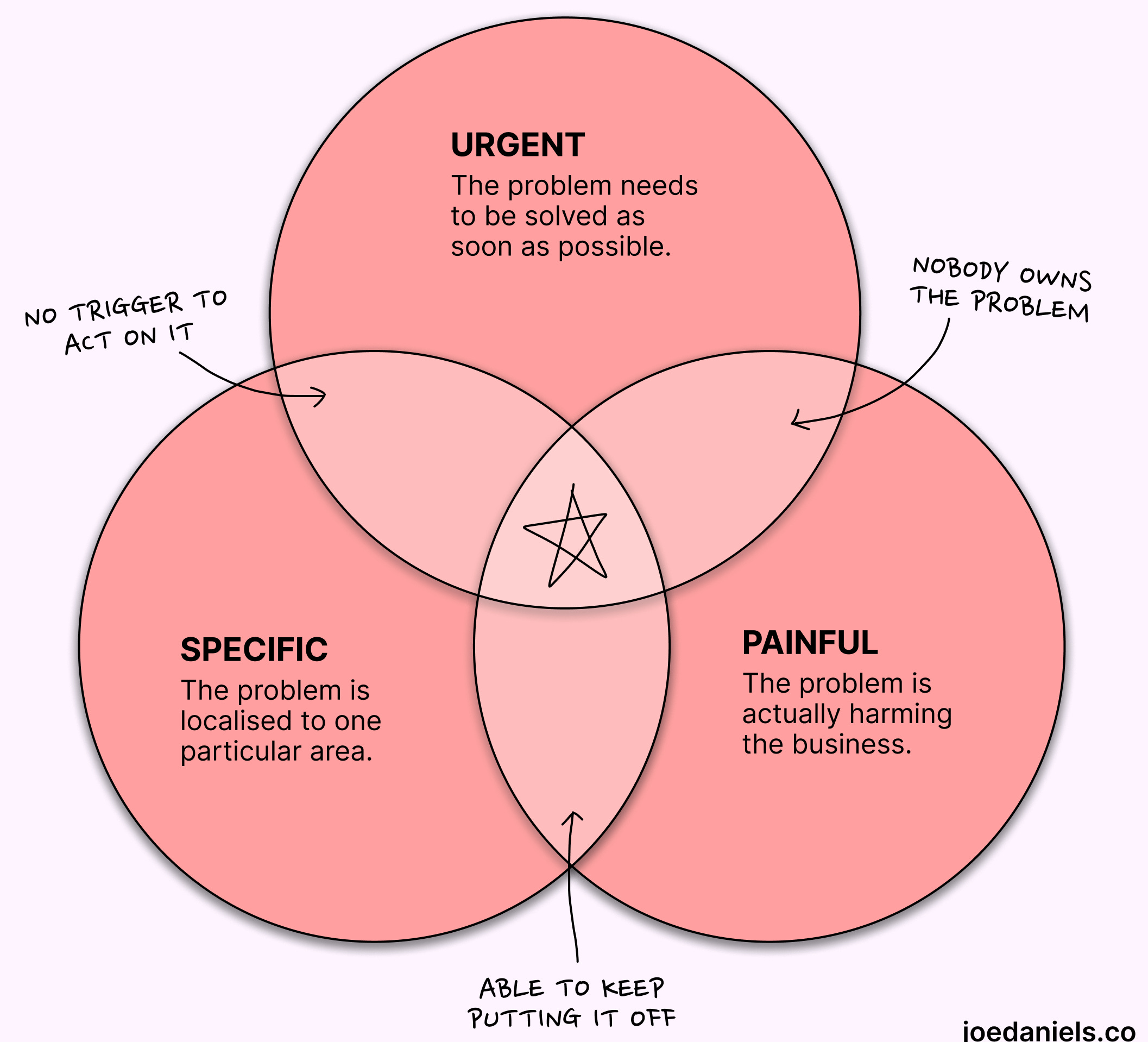
As you can see, there are three key characteristics that the most valuable problems share:
URGENT: Is the problem time-sensitive in some way so that buyers need to make a decision quickly?
“You have leaks in your onboarding journey” = NOT URGENT
“The changing compliance laws mean your cookie use is illegal” = URGENT
Now granted, not every problem can have a looming deadline like a legal change or something exciting like that. In which case it’s important you can at least make an argument for why the problem should be solved sooner rather than later. How will things be made worse if they don’t solve it soon?
PAINFUL: Is the problem actually hurting the business in a meaningful way?
“Your content is only being seen by a few people” = NOT PAINFUL
“You’re losing every pitch to competitors” = PAINFUL
This one should be common sense, but it’s surprisingly easy to focus on a problem that just isn’t that painful. More of a headache than a broken leg. If there isn’t a business-critical problem, then you have to at least ramp up the pains of a less intense problem.
SPECIFIC: Is the problem something that an individual at the company can take ownership of and get solved?
“Your business isn’t growing like it should” = NOT SPECIFIC
“Your website isn’t showing up in AI search results” = SPECIFIC
It’s easy to go generic with a problem, after all that’s how you can hedge your bets and go after multiple client profiles and offer all kinds of services. It’s why full-service agencies struggle with this whole problem-finding exercise. But if one person doesn’t own a problem, then nobody does. And nobody isn’t able to buy your offer.
So to pick the right problem, you need a problem that is URGENT, PAINFUL, and SPECIFIC.
Hmm okay, but how do we actually figure out what the potential problems are?
There’s actually a deceptively simple way of doing this.
It’s an exercise I often do during client immersion that I use to come up with potential problems for them to choose. But you can totally do this exercise for your own business too.
Here’s what you’re going to do…
Make a list of all of the projects you’ve done over the past 6-12 months.
For each project figure out which problem (or problems) you solved.
You now have a new list of problems that you’ve literally been solving in recent months.
Score each of these problems out of 10 for the three characteristics of URGENT, PAINFUL, and SPECIFIC.
Now you can compare the value of each of these problems and identify some frontrunners that score highly across all three.
Told you it was simple.
If you do this exercise and you can’t find any good problems (which is unlikely because that’s basically never happened with a client before) then the alternative is to take a lesser-scoring problem and improve it.
For example, let’s say the best problem on your list was:
“Your company isn’t showing up in AI results and suggestions.”
Now this would score pretty highly on SPECIFIC, average on PAINFUL, and low on URGENT.
Not too bad, but we could make it better. What if we gave some extra context?
“Tomorrow’s customers will shop through AI, but your company isn’t showing up in AI results and suggestions.”
Now with that added context we’ve upped the URGENT score. We’re saying that there’s going to be a shift in consumer behaviour that they need to be ready for. They can’t just put this off.
And finally we can join the dots:
“Tomorrow’s customers will shop through AI, but your company isn’t showing up in AI results and suggestions, so they’re going to end up choosing your competitors instead.”
Now we’ve linked the problem to a clear pain point and upped the PAINFUL score.
Sure it could use some wordsmithing to make it more compelling for potential clients, but the underlying problem is now URGENT, PAINFUL, and SPECIFIC.
So over to you… have a go at this exercise and use the framework to figure out whether you’re solving a problem worth paying for.
And feel free to run your problem by me for some extra feedback.
Until next time,
Joe