

An easy way of thinking about your offer funnel

Should we be thinkers or doers?
That’s often a key debate that agency owners and consultants come to me with. Interestingly, those two types of businesses come to me from opposite ends of the spectrum.
Agency owners are often more likely to be doers. They sell a service focused on execution and delivery. And they come to me concerned that they’re selling a commodity and that AI is going to make delivery obsolete.
Consultants are more likely to be thinkers. They sell a service focused on strategy and ideas. And they come to me concerned that nobody wants to buy “just thinking” and that AI is going to make strategy obsolete.
My solution is this: Don’t pick one or the other. Do both if you can.
In fact, I’ve spoken before about my prediction that the lines between agencies and consultants have become increasingly blurred, and will ultimately disappear altogether in the next 5 years or so.
Now that doesn’t mean you HAVE to do both.
Clients will still pay for doing if you can clearly tie the doing to a painful problem and show that the quality is immensely better than what AI can produce.
Clients will still pay for thinking if you can clearly tie the thinking to a painful problem and show that the quality is immensely better than what AI can produce.
But the real magic lies in combining them together.
And it’s as easy as A C E.
What the hell is ACE?
Usually a playing card. Or an elite fighter pilot. Or a famous video game attorney. (Did anyone else love Phoenix Wright or just me?)
But in this case it’s an acronym:
A-udit
C-onsulting
E-xecution
In other words, it’s a simple flow you can apply to your business to construct something I call an OFFER FUNNEL.
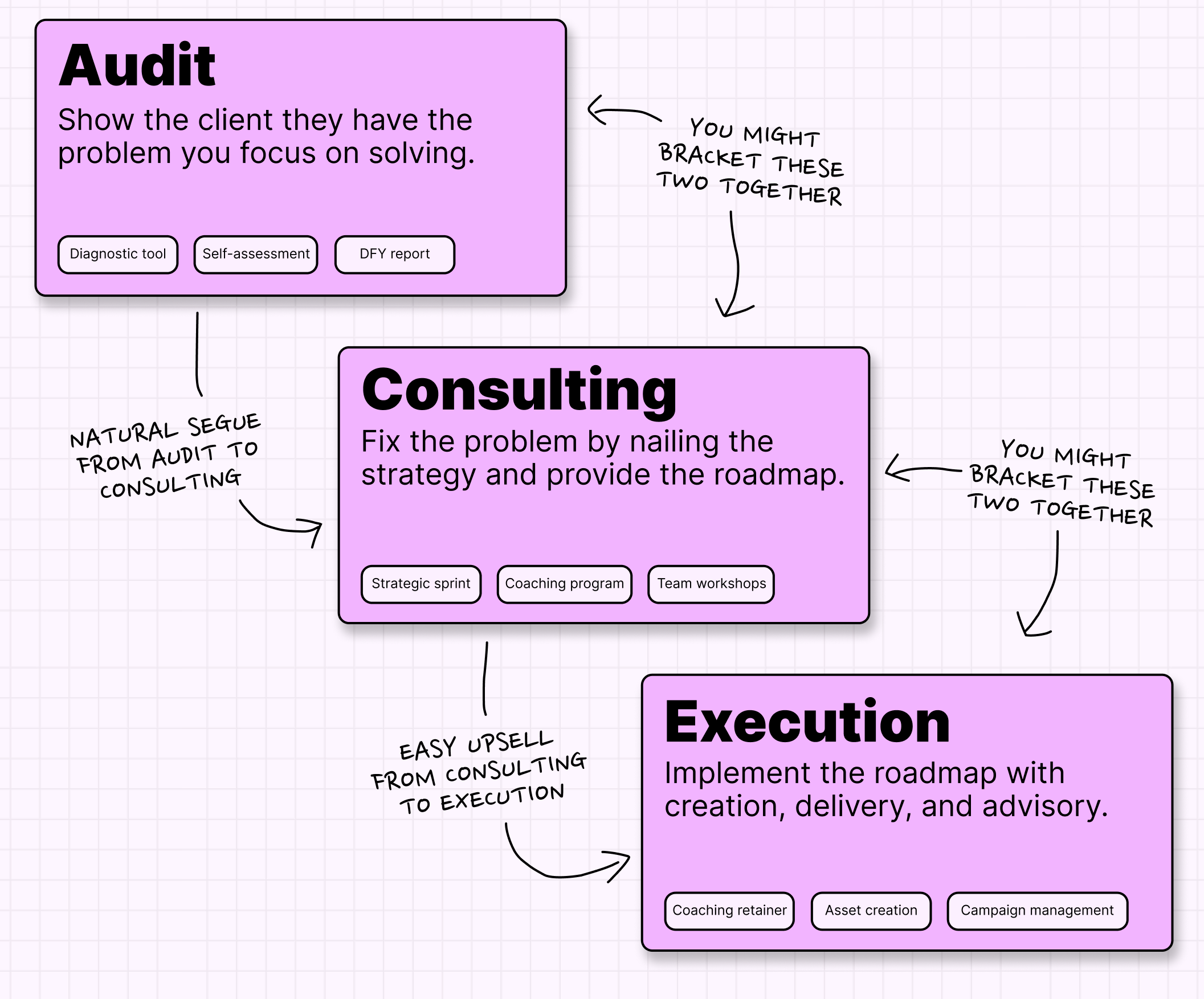
An offer funnel is a series of offers designed to build trust and expand the scope of what you can do in a way that doesn’t just instantly confuse the hell out of your prospects.
You see, a lot of agencies and consultants try to sell all three of these things at once. Because they think more line items equals more value.
The result is a laundry list of different services, different offers, and different packages that ends up confusing prospects and makes you harder to buy from.
But if you can clearly break down your offer (or offers) into these three delivery types, then it makes it clearer for both you and your potential clients to understand.
Let’s take each in turn…
The AUDIT offer…
This is fairly self-explanatory but this is an offer focused on discovery and insight. It’s about looking under the hood of your client’s business, figuring out where they’ve gone wrong, and suggesting some ways of improving it.
It stands to reason, therefore, that this would be the first thing you provide.
You do have a choice here as to whether you charge for this or not. For example, in my offer funnel, I give away 10-minute video audits for free.
This isn’t because it’s not valuable, but because it’s a way of building trust without any large commitment from myself or my client.
Some things to consider:
If you give this away for free, be careful not to give away the actual solution as well. Make suggestions sure, but keep the “how” for the consulting offer.
If you charge for this, make sure you’re actually providing real value. A cursory glance at their google ads dashboard might be fine for a freebie, but not for a paid offer.
If possible, build a face-to-face relationship, either with a call or a video.
The CONSULTING offer…
This is where you provide the actual solution - the “how” - to the problem you’ve promised to help solve. It’ll usually take the form of strategy workshops, team training sessions, or coaching programs. That sort of thing. If your focus is more on the execution side, then this might be where you devise the creative strategy behind those assets and deliverables.
For consultants, this is their bread and butter, their core offer. For agencies, this might be more of a precursor to the main event of delivery and creation.
The big issue I see a lot with agencies is they end up giving this stuff away as part of a pitch or just out of sheer desperation. DON’T DO THIS. Know your value.
Some things to consider:
Thinking is invisible and intangible, so you have to be super duper clear on what your clients are actually getting here. Spell it out.
You might add some delivery to this offer as a way to increase the value and tangibility. For example, instead of a strategy deck, you might write their homepage.
The EXECUTION offer…
This comes after you figure out the “how” with the consulting offer. And it’s where you actually deliver assets of some kind for your client. That might be web copy, content, visuals, ad campaigns, websites, logos. Anything that makes sense to offer as part of the solution to the painful problem.
Agencies will already be used to selling this stuff, but for consultants this might be difficult if you don’t feel you have the skillset. To which the answer is… get better, use AI, or bring in a trusted partner to help with delivery.
Some things to consider:
Within reason the execution can be anything related to the problem you’re solving. But be careful not to just dump a load of possible assets out there. Be intentional with what you deliver.
If you’ve done the audit and consulting offers, then the trust should be sky-high, meaning you can charge what these assets are actually worth and not just be stuck in a race to the bottom with pricing.
But let’s not forget the most important thing… bringing all your offers together.
There’s no use having these three different types of offer if they all feel separate and distinct from one another. It’s supposed to feel like a cohesive ecosystem of offers, with one leading to the next.
So here are three techniques to bring them all together and make your offer funnel as cohesive and easy to buy as possible…
1 — Focus on a specific problem
I’ve written before about making sure you pick the right problem to solve for your clients. It’s arguably the most important thing to consider when making your offer more buyable.
It’s also a really useful way of tying together your multiple offers.
Consider an agency with the following offer funnel:
Audit - We’ll take a detailed look at your current marketing strategy.
Consulting - We’ll come up with a marketing strategy.
Execution - We’ll do your marketing.
Sure, these are all marketing focused, but they’re so broad that you might as well just say “we do stuff”.
But if that agency became clear on the problem they solve, say “Your content isn’t helping with AI search results” then the offer funnel becomes way more specific and way more coherent:
Audit - We’ll assess your content and where you appear in AI search.
Consulting - We’ll help you create an AI-first content strategy.
Execution - We’ll write the AI-first content for you.
This is way more buyable because each of the offers in the funnel are focused on solving the same specific problem. It makes total sense to move from one to the next.
2 — Leave cliffhangers at the end
Another neat little way of ensuring clients move from one offer to the next is to leave what I call cliffhangers. In the same way a TV cliffhanger leaves the audience wanting more and making sure they tune in to the next episode, an offer cliffhanger keeps your clients wanting more.
You do this by teasing the next offer at the end of the previous one.
At the end of the audit, you might leave some potential strategy options and then make it clear that you can help them choose and develop one as part of your consulting offer.
At the end of the consulting offer, you might provide a list of assets they’ll need to execute on the strategy. You can then work through that list and figure out which they’re going to do, which they’ll need a supplier for, and most importantly which you can help deliver for them. (I do this.)
You’d be amazed how many times someone complains to me that nobody is buying more things from them and it transpires they haven’t actually told the client that they can do more things.
3 — Join them up
Whilst the easiest way to communicate your offers is to keep them separate, there are instances where you might want to join them together. I wouldn’t advise on combining all three together but you might do one of the two options…
Audit + Consulting — You might put together a consulting program where the first step is the audit and then the rest of the program is the consulting part. This is a good way of making sure you’re getting paid for the discovery part of the process.
Consulting + Execution — If your focus is on delivery of assets, then you might kick things off with some strategy work to make sure those assets are right. This is a good way of adding value to what would otherwise be seen as just some delivery work.
So now it’s over to you - time to create your offer funnel.
Hopefully you’ll find the ACE model useful for mapping out your offer funnel and making what you do easier to buy.
If you want an extra pair of eyes on yours feel free to send it over and I’ll take a look.
Thanks,
Joe