

Why your ICP is (probably) wrong

Despite my work being primarily concerned with offers, there are two bigger, more important decisions that my clients and I often spend much more wrestling with.
Those two decisions are:
1 — Their ICP
2 — The problem they solve
IMO if you can make those two decisions, the rest of your offer starts to fall into place pretty nicely. The trouble is, these two decisions are usually the hardest to make. And today I want to talk about the first one: your ICP.
If I had a pound for every consultant who tells me they already know their ICP and it turns out they don’t, well I’d probably be writing this from my yacht.
So this is an important topic to read about, even if you’re currently rolling your eyes and thinking…
But Joe, I already know who my ICP is…
Because I’m here to tell you that chances are, unless you’re in the top 1% of consultants, you probably don’t.
Most people I speak to will tell me their ICP based purely on firmographics.
Things like:
Industry
Headcount
Revenue
Company size
Location
And so you get consultants saying things like:
“I’m the SEO consultant for tech startups doing 1m plus revenue.”
“I’m the messaging strategist for dentists based in India.”
“I’m the events planning expert for construction companies with exactly 152 people.”
Now obviously I’m exaggerating here for effect. It’s called hyperbole. Go read a book, jeez. But my point is that this is not a useful ICP.
Because that SEO consultant might message two founders that fit the bill and discover that one is ready to go right away and the other doesn’t want SEO.
But they’re the same ICP? Shouldn’t both want SEO?
That messaging strategist might find that some dentists don’t even have a website, while others desperately need their help.
But they’re the same ICP? Shouldn’t they both need the same thing?
And that events planning expert, well to be honest they’re probably screwed.
But isn’t this just following the advice to niche down?
“Just niche down” might be one of the most-followed bad pieces of advice in the marketing world. Don’t get me wrong, it’s a well-meaning phrase. And it’s not entirely incorrect. But it’s a massive oversimplification. Which means people blindly following it are going find themselves in a worse position.
Most people see “just niche down” and read it as “pick an industry to specialise in”. Which is how you end up with those kinds of awful ICP examples I gave above.
The reason is this: the easiest niche to choose is one you can instantly see or visualise. And those surface-level firmographics are easy to see. You can use them as filters on LinkedIn or Clay or whatever the hell the hot new martech tool is. They’re obvious. And obviously that’s why they don’t work.
It’s why I call these SHALLOW ATTRIBUTES.
They’re the fish that lurk just under the surface so you can easily see them and catch them. The problem is, if you can see them, so can everyone else. And so you end up fishing in the same pond as all the other consultants and service providers.
Oh, and the tastier fish? They’re hiding deeper down in the murky depths.
That’s one analogy anyway. Another one is this iceberg. Or ICP-berg if you will.
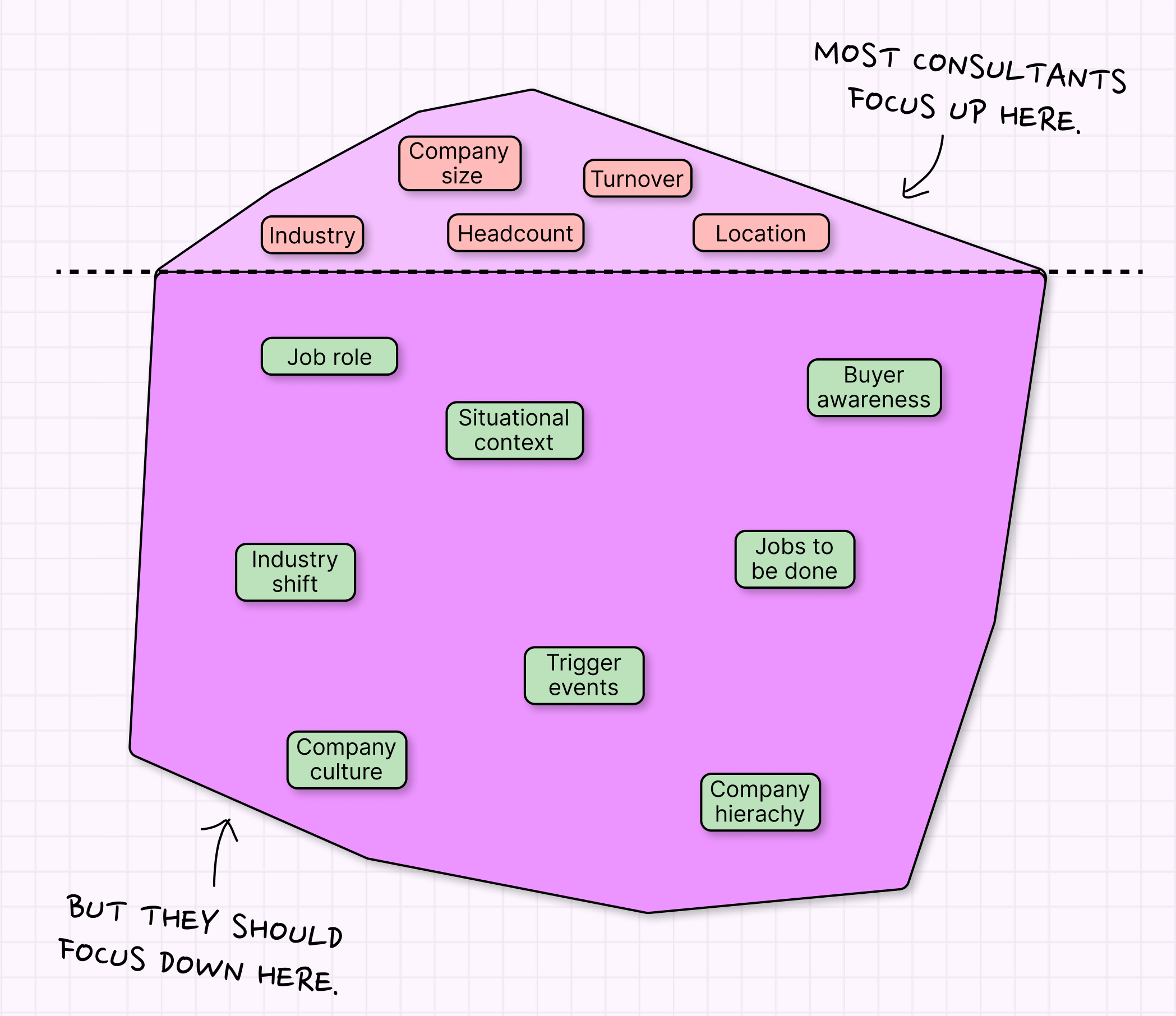
Okay, so those bottom attributes are better?
Yep! I call those the SUBMERGED ATTRIBUTES because I like to give things a name and this one sounds cool.
These are things like:
Job role
Situational context
Buyer awareness
Industry shifts
Trigger events
Company culture
Company hierarchy
Jobs to be done (JTBD)
(The ones in bold are arguably the most important ones to focus on when it comes to choosing your ICP and then framing your offer.)
There are two main reasons these submerged attributes are better…
A) They actually influence buyer behaviour
As I explained earlier, two prospects being in the same industry doesn’t mean both need your solution. But if you take two prospects with the same JTBD or the same trigger event or the same situational context, then chances are they both need your solution.
In other words, these submerged attributes are a much more accurate indicator of whether somebody is in the market for your offer.
B) They don’t needlessly narrow your market
If you pick an industry and go all-in, then you’re obviously limited to that industry. In that example I shared, that poor messaging strategist is now doomed to work with dentists in India their whole career. Or will have to do some painful repositioning work in the future.
But if you pick a JTBD as your focus, then that might exist across industries, across company sizes, across locations. You’re focusing but without needlessly narrowing. Of course, after you pick some submerged attributes, you can still use shallow ones to pad out your ICP if you actually want that focus. But you aren’t constrained by it in the same way.
Okay, so how do I actually use this?
When it comes to picking your ICP, here’s the stages I’d go through…
1 - Look at your best work
List out all of the clients and projects where you believe you did the best work, where you were paid well for it, and where everyone was happiest.
Now instead of looking for similarities in terms of shallow attributes, look deeper. What did these best-fit clients have in common in terms of JTBD, or the reasons for coming to you, or their awareness of what you actually do?
Then pull these commonalities out and you’ve started crafting your ICP.
2 - Formalise your choice
At this point you might have several characteristics flying around. You need to choose 2 or 3. And at least one of them should be one of the ones I bolded in the list above.
This gives you the core ICP.
3 - Add any extra layers
At this point, if you want to, you can bring in some of the shallow attributes to help you segment your marketing. But this is optional, and only if you want to help focus your messaging and offer.
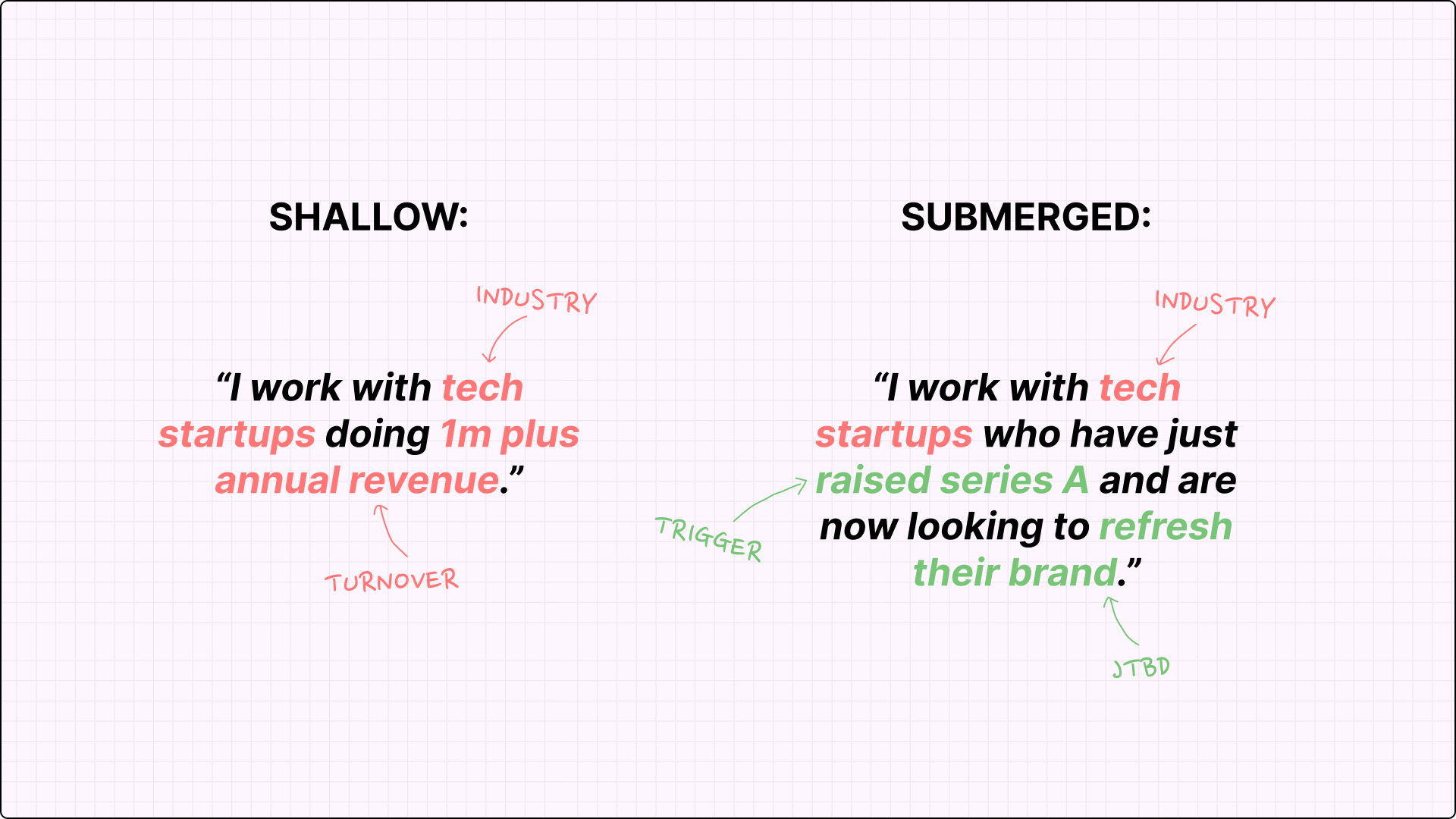
Here’s a shallow ICP vs submerged ICP to show you the difference:
Shallow = “I work with tech startups doing 1m plus annual revenue.”
Submerged = “I work with tech startups who have just raised series A and are now looking to refresh their brand.”
As always, thanks for reading!
Oh, and I’ve just launched a power hour offer. You can book a 1-hour session with me and we’ll try to solve your biggest offer obstacles together. We could even try to nail down your ICP! You can book that here.
Thanks,
Joe