

Why you should actually sell risk reduction

When I told my dad I wanted to open a bar, he sat me down, rested a hand on my shoulder, and warned, “Son, that’s a whisky business.”
Anyhow, today I want to talk about risk. You might’ve guessed that from the header.
You see, it turns out that a lot of agencies and consultants are focused on the wrong thing. They’re trying to sell aspiration. But the reality is we should be selling risk reduction.
And that’s a more important distinction than you might think…
But first, let’s talk about Simon Sinek.
I have a bone to pick with Simon Sinek. His “Start With Why” mantra is undoubtedly a great idea. It’s well-packaged, it’s catchy, it’s simple.
But it’s also not the whole truth.
If you take his idea at face value (and most do) then you’d be forgiven for believing the key to success lies in doing a deep dive into why you started your business and then shouting that from the rooftops like some sort of street preacher.
Only, that doesn’t really work. At least not for a high-ticket, high-consideration B2B service offer.
The harsh truth is that pretty much every B2B buyer is selfish. They’re in it for themselves. And so they should be. They’re the ones potentially making the purchase after all. It has to work for them. It has to work for their organisation.
And so your mission statement - your why - might sound nice on paper but it doesn’t do anything for your buyers.
Unless you clearly explain why they should care.
Perhaps a more accurate (though admittedly less catchy) mantra should be:
”Start with why I should care.”
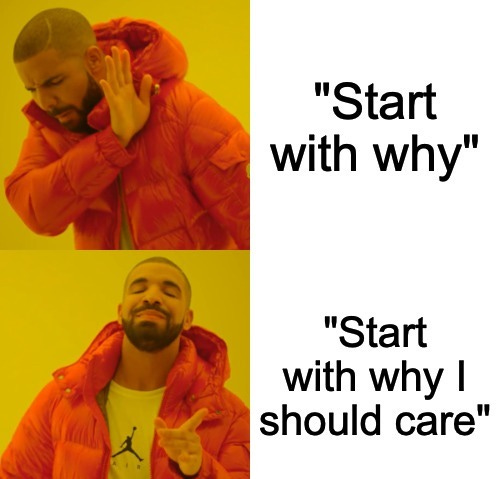
But this cult obsession with Sinek’s philosophy has led a lot of agencies and consultants down the wrong path.
They focus on their “why”, their manifesto, and so their websites say crap like:
“Reimagining business.”
“We don’t do ads, we do brand amplification.”
“We want to revolutionise innovation itself.”
Even worse are when agencies start spouting on about the founder’s origin story like they’re some sort of messiah. NOBODY CARES.
But isn’t emotion a key driver of decision-making?
Yes and no.
It’s absolutely true that emotions play a big role in our decisions. Yes, even for B2B purchases. But there’s also an element of logical, rational process that goes into most B2B buying journeys.
Unlike a spontaneous Kinder Bueno purchase at my local shop, I’m unlikely to just splurge my hard-earned cash on a new agency without doing some due diligence. I’m still going to compare to other options, explore other avenues, and make sure the agency in question can actually help me.
Ultimately, there’s more money involved (usually), there are more people involved, and there’s more to lose.
Which brings me to my point…
Agencies and consultants are focusing on the wrong emotion.
They’re aiming for aspiration, when they should really be aiming for risk reduction.
Hmm, risk sounds a bit stuffy and boring though. And we’re creative and interesting.
That attitude there is exactly what holds most agencies and consultants back.
Because the fact you’re creating and interesting is EXACTLY why buyers see you as a risk. Because they don’t always understand your creativity. Because a lot of B2B buyers are in an environment where interesting = risky.
Like I said earlier, there are three reasons a B2B buyer wants to minimise risk:
There’s more money involved. These are often big purchases.
There are more people involved. These are often group decisions.
There’s more to lose. Their reputation. The company’s results.
When people used to say “Nobody gets fired for hiring IBM” the point they were making is that your job is safe as long as you go with the safe, established solution.
But chances are your agency is NOT the safe, established solution. You’re probably the new entrant, the smaller fish, the riskier bet. Which means you’re facing an uphill battle to convince buyers to part with their money.
Because people might get fired for hiring you.
And so to be absolutely clear: yes there is emotion involved in B2B buying. But that emotion isn’t aspirational… it’s fear.
Okay okay, so I need to show buyers that we aren’t a risky choice?
Correct.
And here’s how you can do it. (Spoiler: it’s about buyability.)
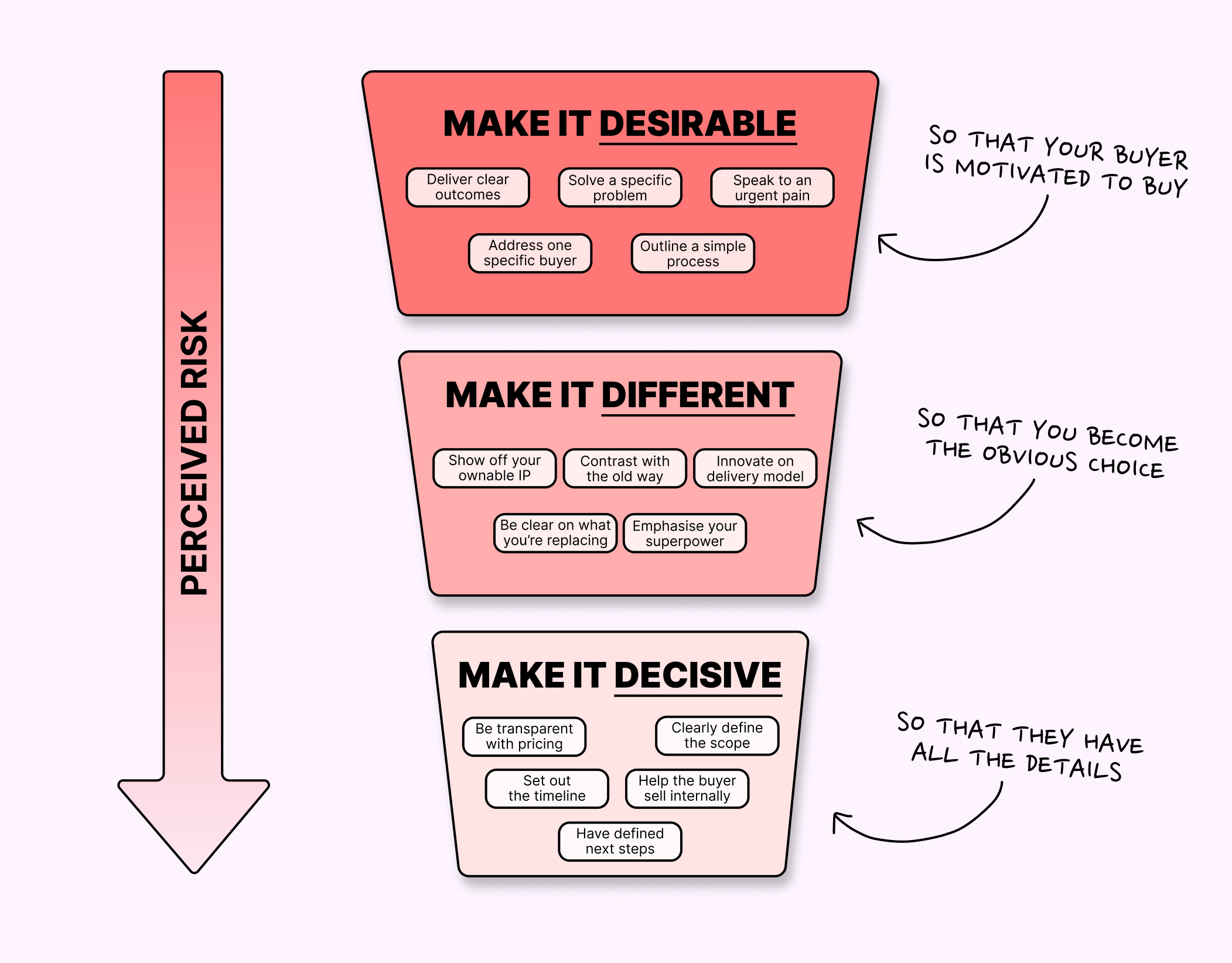
Firstly, here are the three pillars of buyability:
DESIRABLE — Is the value clear?
DIFFERENT — Is it the obvious choice?
DECISIVE — Is all the info there?
Now it just so happens that this model was designed (in part) to help agencies and consultants reduce the perceived risk of their offer.
And so the key to making your offer less risky is to make sure each of these pillars is covered when you create and communicate your offer.
Let’s take each in turn…
Make it desirable.
This is all about making the value of your offer so clear that your buyer a) understands why they need it and b) really fucking wants it.
To do that, you need to:
Deliver clear outcomes — otherwise they won’t see any value.
Solve a specific problem — otherwise they aren’t feeling the pain.
Speak to an urgent pain — otherwise they’ll keep putting it off.
Address one specific buyer — otherwise nobody owns the deal.
Outline a simple process — otherwise they don’t know what they get.
Do those things and your buyers will be way more motivated to get this deal signed and over the line.
Make it different.
This is all about making it clear that you’re the only real option when it comes to solving the problem.
To do that, you need to:
Show off your ownable IP — otherwise you sound the same as the others.
Contrast with the old way — otherwise they won’t get the context.
Innovate on delivery model — otherwise you’re doing the same kind of thing.
Be clear on what you replace — otherwise they can’t see where you fit.
Emphasise your superpower — otherwise they won’t see your unique value.
Do those things and your buyers will be more certain that you’re the best option to go with compared to the others.
Make it decisive.
This is all about equipping the buyer with all the details they need to make the purchase decision. And the more you do this upfront the better.
To do that, you need to:
Be transparent with pricing — otherwise they won’t know how much to budget.
Clearly define the scope — otherwise they won’t know what they get.
Set out the timeline — otherwise they don’t know what to expect.
Help the buyer sell internally — otherwise they’ll hit roadblocks.
Have defined next steps — otherwise they’ll be uncertain about proceeding.
Do those things and your buyers will be confident that they know everything they need to know (and are ready to sell internally if they need to).
Here’s a handy infographic to summarise:
That’s all from me today. The key takeaway is this:
“Becoming more buyable means reducing the risk.”
Thanks for reading,
Joe
Psst. Hey. Hey you. Yes you. How about you see just how buyable your offer is with my free AI offer analysis tool?