

These three things are blocking your buyers

Some blocks are good. Lego. Jenga. New Kids On The.
But some blocks are bad. And those are the kind I want to talk about today.
One of the underlying reasons for creating my buyability framework like I did was because after years of working with agencies I found three main reasons that attracting and convincing clients was an uphill battle.
And as it happens each of the three layers of buyability is designed to overcome each of those three buyer blockers.
But first…
Here’s why it makes more sense to think in terms of buyer blockers…
Most sales advice is seller-centric. That makes sense because more often it’s easier to focus on yourself and what you can do to fix a situation.
But it also misses the point. The point being: you aren’t buying your offer.
And so if you aren’t seeing things from your buyer’s perspective, then you’re probably withholding crucial information or detail from them without even realising. You’re probably putting them off before you even become acutely aware of their existence.
In short, a seller-centric approach is bad for business.
Which is why buyability exists. Because it helps to shift perspective and start seeing things from the buyer’s point of view. Because that buyer-centric approach is what takes you from sales slog to go-to expert.
And when you look at your offer from your buyer’s perspective, you’ll realise they have three major objections they need to get past.
(There are obviously some more minor, more specific objections as well but that’s not the point of this newsletter.)
Okay okay, so what are these three objections?
It might make more sense for me to pose them as questions. Questions that left unanswered severely decrease the chances of them ever reaching out to you.
The questions - or buyer blockers - are:
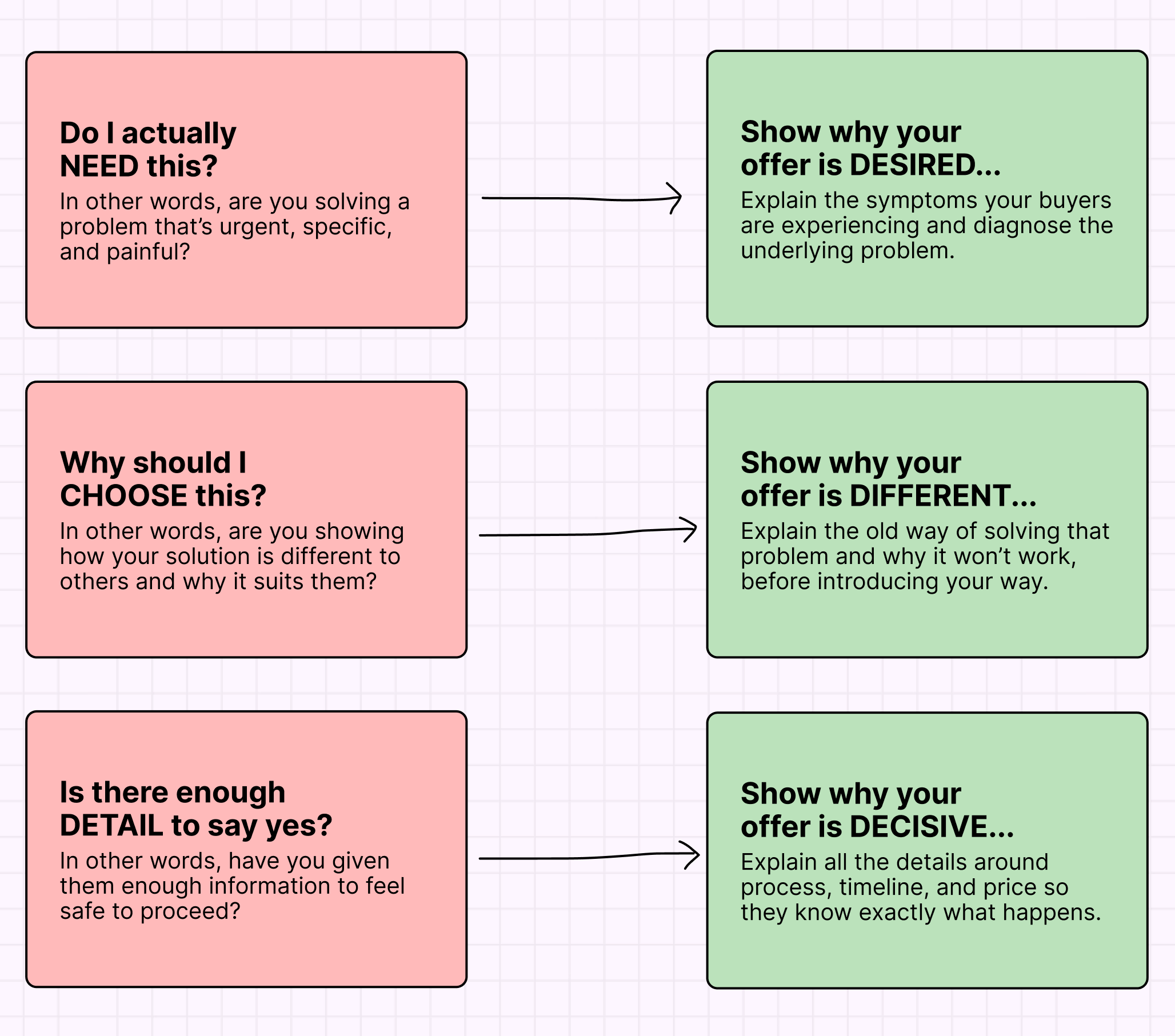
1 - Do I actually NEED this?
2 - Why should I CHOOSE this?
3 - Is there enough DETAIL to say yes?
And the more astute amongst you might realise that those three things map very nicely to the three layers of buyability…
1 - Do I actually NEED this? —> Desired
2 - Why should I CHOOSE this? —> Different
3 - Is there enough DETAIL to say yes? —> Decisive
It’s almost like I’ve thought this through.
Let’s take it one a time…
1 - Do I actually NEED this?
This is usually the first hurdle to leap over. If a buyer can’t even see why they need your solution, then they’re never going to buy it. They won’t even care to learn more.
And yet one of the most common issues I see with agency and consultant sites is jumping straight in with the service-slapping. Giving a long list of different services and offers as if that’s all they need to do to convince a buyer to get in touch.
But let’s look at it through the buyer’s perspective.
A buyer is only looking for a solution if they need something solving.
That sounds obvious but a lot of people overlook this. Nobody is buying SEO because they just love SEO so much. They’re buying it because they aren’t getting enough traffic. Nobody is buying project management because they’re nerdy about Asana. They’re buying it because they’re drowning in to-do lists and tasks.
In other words, as much as you care about your solutions, your buyers care more about their problems.
So if you want your offer to be desired - and overcome this blocker - you need to show them exactly why it’s needed.
Which means starting with the symptoms and pains your buyer is feeling. This builds rapport, gets them nodding along in agreement, and shows you understand their situation.
Then introduce the underlying problem that you’ve diagnosed (and that your solution will fix). This is how you start to convince them that you’re the expert here. But more importantly, it helps them realise they need this problem solving. And they need it solving NOW.
They go from “hmm well maybe we could use some SEO help” to “if we don’t get SEO help then we may as well pack in the whole business”.
2 - Why should I CHOOSE this?
Now that your buyer knows that they desperately need your solution, there’s still another obstacle.
Because now they’re solution-aware but not necessarily vendor-aware. In other words they know they need SEO, but they don’t know who they should choose to do it. After all, most solutions aren’t the ONLY solution to that problem.
For example, they might think they can do SEO themselves in-house. They might think they could just hire a marketer to do it in-house. They might think AI can do it. They might know they want an agency but don’t know which one to pick.
There are often dozens of potential options they can take.
Your job is to contrast the default way of solving their problem with your way of solving their problem.
Imagine the buyer is at a fork in the road and they don’t know which fork to take. You have to show why one fork isn’t going to get them where they need to go, and why the other fork (your fork) will.
This is how you get past the table-stakes differentiation claims like “we care more” or “we focus on results” or “we’re nice people I promise”.
3 - Is there enough DETAIL to say yes?
Okay so your buyer now a) knows they need to solve this problem and b) would really prefer you to solve it for them. So that’s it then, right?
Wrong.
Because there’s still inherent risk attached to going with your solution.
Remember the whole “nobody gets fired for hiring IBM” thing? Well even if IBM isn’t the default choice anymore, there’s still going to be a safer option for your buyer. Maybe it’s doing nothing and burying their head in the sand. Maybe it’s just going with the same old approach because “hey it must work for everyone else”.
But more often than not, the final hurdle is simply this: there are still too many unknowns.
If your buyer doesn’t know all the details, then they’re less likely to reach out. That’s just a fact. Especially in today’s era of self-serve buyer journeys. Maybe ten years ago buyers were more willing to book a call and chat to you about how you can help. But those days are ending fast. A new generation of buyers is here and they will absolutely NOT want to do that.
Today’s buyers want as much information as humanly possible ahead of making any decision to talk to you.
Let me repeat that because it’s important…
Your buyer wants all the information BEFORE they speak to you.
I’m talking about the process, the deliverables, what’s included, what’s not included, how much time it takes, how much time they need to spend, and of course the big one: how much will this cost?
The more of this stuff you can communicate, the more likely they are to go ahead and chat to you. And not just that but chat to you with that all-important purchase decision practically made already.
Cool I get it. I need to address those buyer blockers or it’s game over.
Basically yeah.
Here’s a neat little visual summary for you:
Remember - if you have any questions about the stuff in this newsletter I’m all ears. Just reply to this email and I’ll get back to you.
Thanks,
Joe
PS. I’m launching a new content series on LinkedIn where I publicly ROAST people’s offers. In exchange, any roastees have a chance of winning a 1:1 session with me. If you’re interested in being publicly humiliated then let me know.