

The Future of Selling is... Marketing?
(Or, why it's about goddamn time we just joined these two departments up anyway)

What does JFK have in common with B2B organisations?
They both love silos.
Ba-dum-tish.
No but seriously, pretty much every company I’ve ever worked with has prided themselves on their org chart.
It’s usually stuck up on the wall in a nice ornate frame, large and imposing. Because nothing says “we’re a big grown-up company” like a complicated hierarchy.
And look, in all fairness, I do think there’s a valid reason to have departments. And I’m also aware that departments can (and do) work together very closely. But there’s one cross-departmental divide that’s never made sense to me.
The one between marketing and sales.
Because this is more than a divide. More than a “we live in different offices” vibe. No, more often than not, it’s a full-on hatred of one another. Sales loves to blame marketing for the lack of leads. Marketing loves to blame sales for the lack of conversion.
But all the while the truth is it’s both their faults. Ultimately, both marketing and sales are primarily concerned with increasing revenue. And if that’s not happening, then both their necks should be on the line.
Now, in agencies, that divide is often a lot less pronounced. Up to a certain point, the agency owner will often be the sole marketer and salesperson. They may hire some kind of executional help but for the most part it rests on their shoulders. The “new business” term is essentially designed to bridge that marketing/sales divide.
But we could do better.
Because if we flip this round and look at it from a buyer’s perspective, there are really two stages for their relationship with an agency.
1 → Before they become a client.
2 → After they become a client.
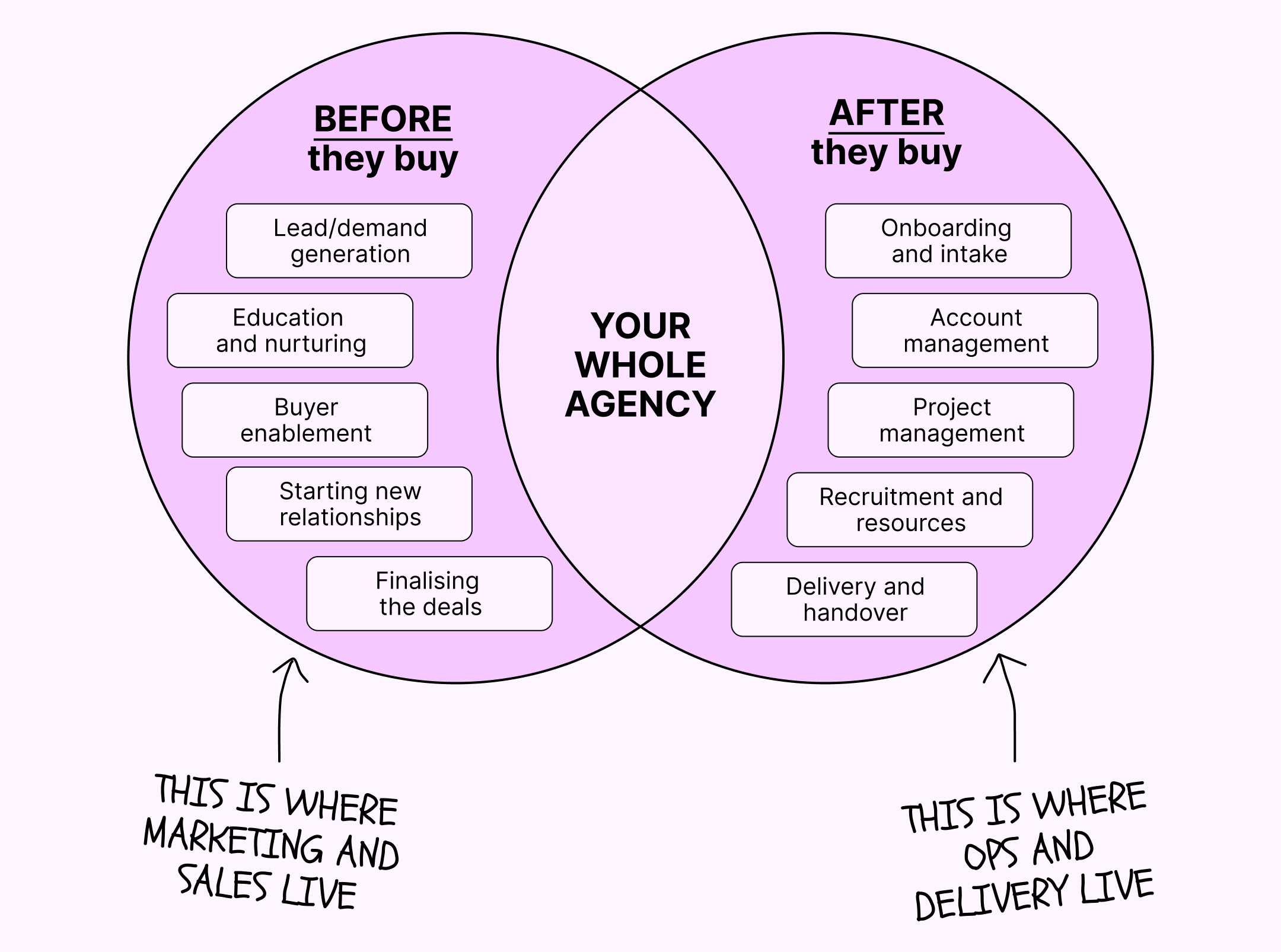
As you can see from his diagram, everything your agency does can be split into these two buckets. And for the purposes of this essay I want to draw your attention to the left-hand circle.
This is where marketing and sales live. Their whole reason for existence is to help the buyer move across to the right-hand circle.
But the key thing to note is this:
From the buyer’s perspective, marketing and sales is the exact same thing. They don’t care about funnels or how you’ve split your CRM into neat little stages.
And so it’s safe to say that the separation of the two makes no sense from the buyer’s point of view.
But you’re probably thinking…
Okay sure, but we need to split them internally!
Do you though?
Like I know people get weirdly obsessed with job titles and all that shit but do you actually need to split them up?
What is splitting them up going to solve? Other than having an extra couple of branches on that big shiny org chart monolith, how does it actually help you?
It’s true that when you dig deeper there are slightly different objectives between marketing and sales. Because naturally they’re dealing with different stages of the buyer journey. But I’d argue that onboarding and offboarding are two different stages of the client relationship - and I’m guessing you don’t have an “onboarding department”.
That internal split usually does more harm than good.
Because it suggests different goals, different metrics, different responsibilities. And that’s how things (often the buyer themselves) fall through the cracks. It’s why teams end up blaming each other instead of taking responsibility themselves.
(As a side note, it’s also why marketing is now relegated to a nice-to-have department. Because it’s lost touch with the actual revenue generation that it’s supposed to be responsible for.)
Look I get it. It’s way easier for marketers to blame their lack of performance on the “closers”. And it’s way nicer for salespeople to blame their lack of performance on “bad-fit leads”. But neither of those things actually helps the business to grow.
The blame game helps nobody.
But all of this is actually pretty irrelevant, because here’s the final nail in the coffin…
If selling is now about buyer enablement, then it becomes the same thing as marketing.
Okay bear with me here. Put that pitchfork down for just a moment.
I’m always throwing out stats to back up what I say about buyer behaviour and preferences changing.
And one I keep on coming back to is this:
61% of B2B buyers prefer a rep-free experience. (Source)
Just let that sink in. The majority of your buyers would rather self-serve their way through the buying journey.
See how that statement is at odds with literally every piece of sales advice?
This is the great seller-buyer divide I spoke about here:

Most sales advice revolves around:
→ reaching out to people
→ building relationships
→ improving your pitch
→ getting people on a call
But all of those things are inherently not rep-free. In fact they’re very much rep-full.
In other words, all that sales advice (that maybe once upon a time was useful) now goes AGAINST how most buyers want to actually buy.
Now let’s list out what they want instead:
→ transparent pricing and scope
→ examples of work and case studies
→ content that explains the problem
→ self-diagnostic tools and quizzes
This is the stuff I’m talking about when I talk about buyer enablement and buyability. It’s the provision of all the information a buyer needs to make that purchase decision.
You need to give them every little thing they need to know BEFORE they speak to you or a salesperson. Before. Not during. Not after. Before.
Hang on a minute though.
Let’s just take another look at that list. Because it looks to me like there’s something a little weird about it.
Hmm. It seems to me like all that stuff I just said was the new way of selling is actually part of marketing’s remit right now.
If marketing does their job well, they tap into the buyer’s demand, give them a load of useful information, and lead them towards the purchase decision. Usually that’s when sales shows up to “always be closing” or “sealing the deal”. But the point is the majority of the work should now be done before that ever happens.
It’s about building trust and getting the buyer 90% of the way to making that decision before they ever reach out (and please note that THEY reach out to YOU, not the other way round).
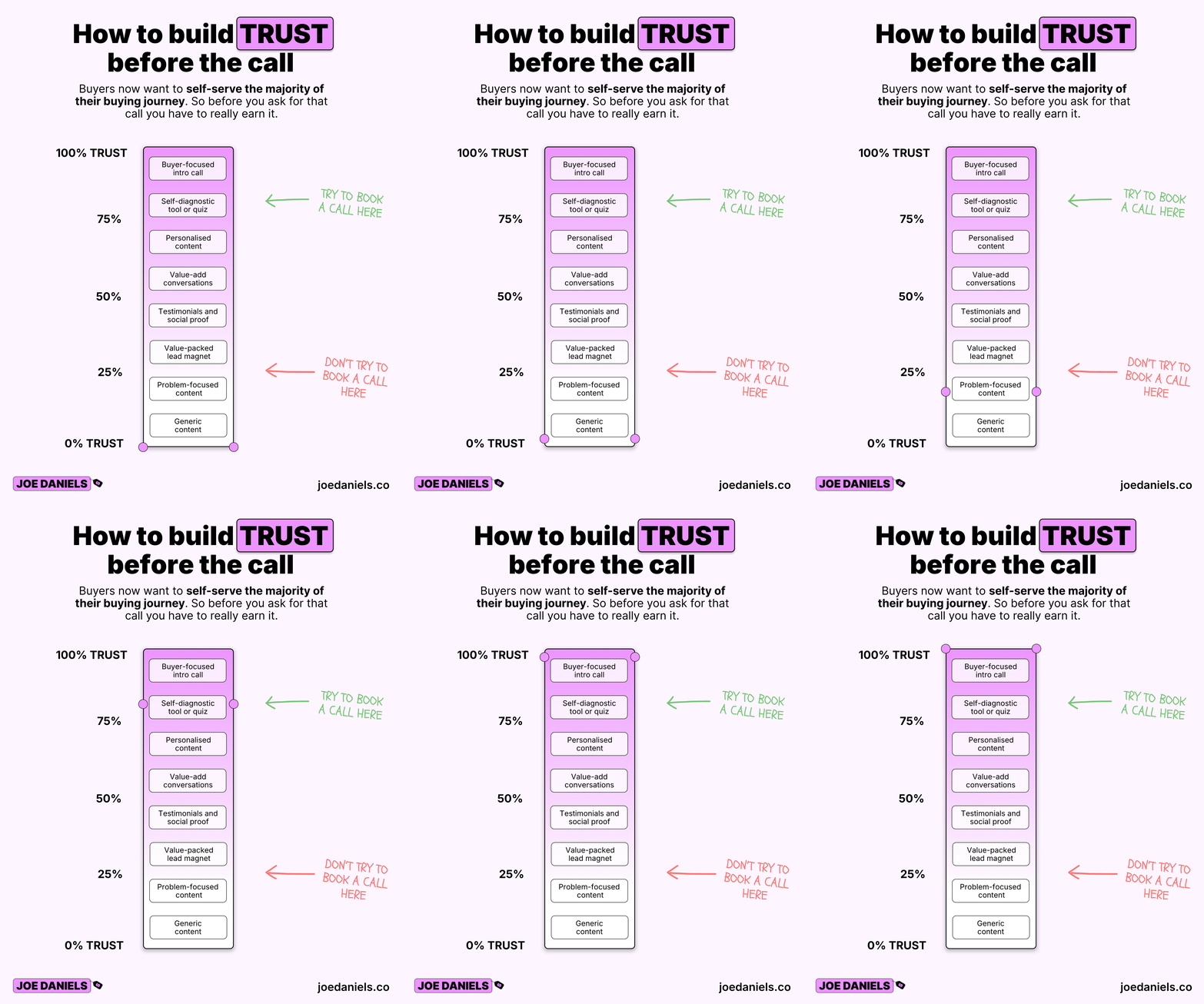
Wow, so are you saying that selling is dead and salespeople should just give up?
No.
And this brings me full circle to the point of this essay… that marketing and sales should be two parts of the same whole. And that instead of arbitrarily splitting them up, we should combine them.
Call it the “revenue department” or “new business team” or “money-making legends” if you want. The name doesn’t really matter. (Though I do like Buyer Enablement.)
What matters is that they’re united behind the same goal of helping the buyer understand what you’re offering, why they need it, and how they can buy it.
It means salespeople can start adapting to some of the marketing stuff. And it means marketing can start acting more like they’re actually a revenue-driving function.
And remember, this isn’t just my random opinion. It’s literally based on how today’s buyers want to buy. It’s based on seeing hundreds of agencies struggling with sales because they was this massive misalignment. And ultimately it’s based on a bit of common sense.
So it looks like you’re going to have to tear up that precious org chart. Sorry, not sorry.
Phew you made it to the end. Good work. Hopefully you found this valuable. If you did please do share it around with others. Oh, and if you’re wondering just how buyable your agency’s offer is then why not give the self-assessment a try.