

Show me the money!

Sure Tom Cruise might be a scientologist but when he shouts “show me the money” in that infamous Jerry Maguire scene he might well be onto something. He probably didn’t realise this at the time but he was actually setting up a perfectly wild intro to my newsletter. Weird how the world works.
Today I want to talk about pricing and transparency. More specifically I want to talk about pricing transparency.
I know, I know. Yawnfest right?
But whilst this email will focus on pricing transparency, it does also get at a deeper issue around a startling lack of transparency when it comes to how consultants sell their services.
Because here’s the headline news for this email:
69% of buyers cited “lack of transparent pricing” as the most frustrating thing about B2B buying. (Source)
Ouch.
That means there’s a serious disconnect going on between how people want to buy, and how people are selling to them.
This buyer-seller divide is at the core of my buyability philosophy. It’s a big problem. Because it means consultants like you are being given outdated advice. And “hide your prices” might be one of the most damaging myths out there.
But all the sales bros tell me I should save my pricing for the call.
They sure do. But that’s because they’re thinking about this from the seller’s perspective. And that can only get you so far. What you need to do is think about this from the buyer’s perspective.
Sellers seem to think that when a buyer lands on a site and sees no mention of pricing that they’ll think something like:
“Ooh no pricing. How sexy and mysterious. I love how they’re playing hard to get. I want them to marry me.”
But the reality is that a buyer will see no pricing and think:
“Hmm no pricing. It might be too expensive for me. Or maybe they’ll try to squeeze as much money from me as they can. Sounds awkward.”
And in a lot of cases that buyer is going to leave without ever reaching out to you. Especially if other potential vendors ARE communicating their pricing. Did somebody say competitive advantage?
This is the opportunity cost of hiding your pricing that a lot of consultants don’t recognise. Because it’s invisible. You don’t see the potential clients who land on your site, don’t see pricing, and then leave as a result. And because you can’t see them you assume it’s not happening.
But in my experience it absolutely is happening. A silent majority of prospects are never reaching out because you’re hiding your pricing.
But I can’t publish my pricing because prospects won’t get the value until they speak to me.
If that’s the case, then you’re essentially gatekeeping your brilliance. A lot of consultants do this. They hide their expertise away in the hopes that someone will book a call and then they can bamboozle them with ideas and strategy and genius.
But what ends up happening is nobody books a call. Or if they do, that bamboozling only serves to confuse them further. You come across like a mad person.
So what if instead of saving all those great ideas for the call, you put them out there in the form of content? What if you started showing your expertise for all to see?
Well if you did that I think you’d find way more people willing to get on a call with you. And then rather than an opportunity for you to desperately convince them you’re a genius, that call can be used to actually listen to their situation and decide if you’re a good fit to help them.
It’s absolutely true that transparent pricing only works if you can clearly communicate the value and justify that price. But that’s not a reason to hide your pricing. It’s an excuse. Because if you aren’t able to clearly communicate the value, then you need to figure out how to.
That’s why I always insist that my clients include a clear “problem section” on their site or landing page. That’s the section where you really ramp up the pains your prospects are facing and show why that price you’ve stated is worth it.
But I can’t publish my pricing because my offer changes from client to client.
Again, this is an excuse, not a reason. Because your offer shouldn’t be changing from client to client. At least not massively.
If there’s such a big difference each time then you’re basically building a new business every time you find a prospect. And that’s just adding unnecessary work and stress to your table.
This email isn’t about the multiple reasons for having a standardised offer so I won’t go into it here. But one of those reasons is that it enables you to actually publish your pricing.
Now look, in the event that you’ve almost standardised but there’s still a bit of leeway with deliverables or process, then here’s what you do instead…
You give a range. Something like “Pricing ranges from £5,000 to £8,000 depending on project complexity.”
Make sure you actually give a reason behind the range. Otherwise you just leave them guessing.
Alternatively, you can have a “Starting from £5,000” price. Again, be clear on why it might end up costing more.
Ultimately though, the tighter you package up what you do, the easier it is to communicate the value, scope, and therefore pricing.
But I can’t publish my pricing because I have multiple target clients.
Okay I want to be very clear on this… Every target client profile you have is essentially adding another business for you to market and sell to.
For large businesses with a dedicated marketing team and multiple sales reps that’s fine. Encouraged, even. But for consultants - who let’s face it are already spread too thin anyway - this is a surefire way of failing.
It’s like trying to run in two directions at once. You just end up exactly where you started except you’re also tired.
So I beg you to focus in on one core ICP. I BEG YOU.
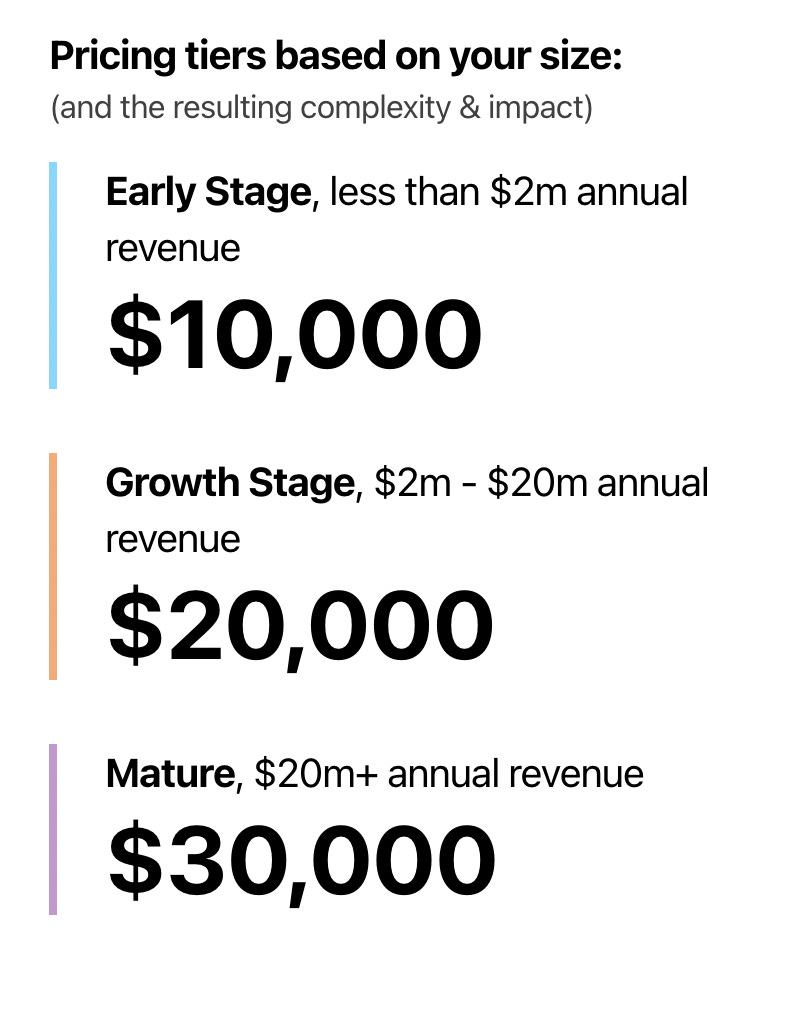
That being said, if you do have multiple target clients (or there’s a bit of a spectrum - on size for example) then it might be tough to have one fixed price. In which case, I recommend using the range or starting prices that I explained in the section above.
The guys at Fletch do this well - clearly explaining the different pricing tiers aimed at different sizes of client.
So what you’re saying is everyone SHOULD publish pricing, but you have to EARN the right?
Actually yeah. That’s exactly what I’m saying.
Transparent pricing is the gold standard. I genuinely believe every business should have some form of clear pricing for anyone to see.
But to do that you have to get some other things right.
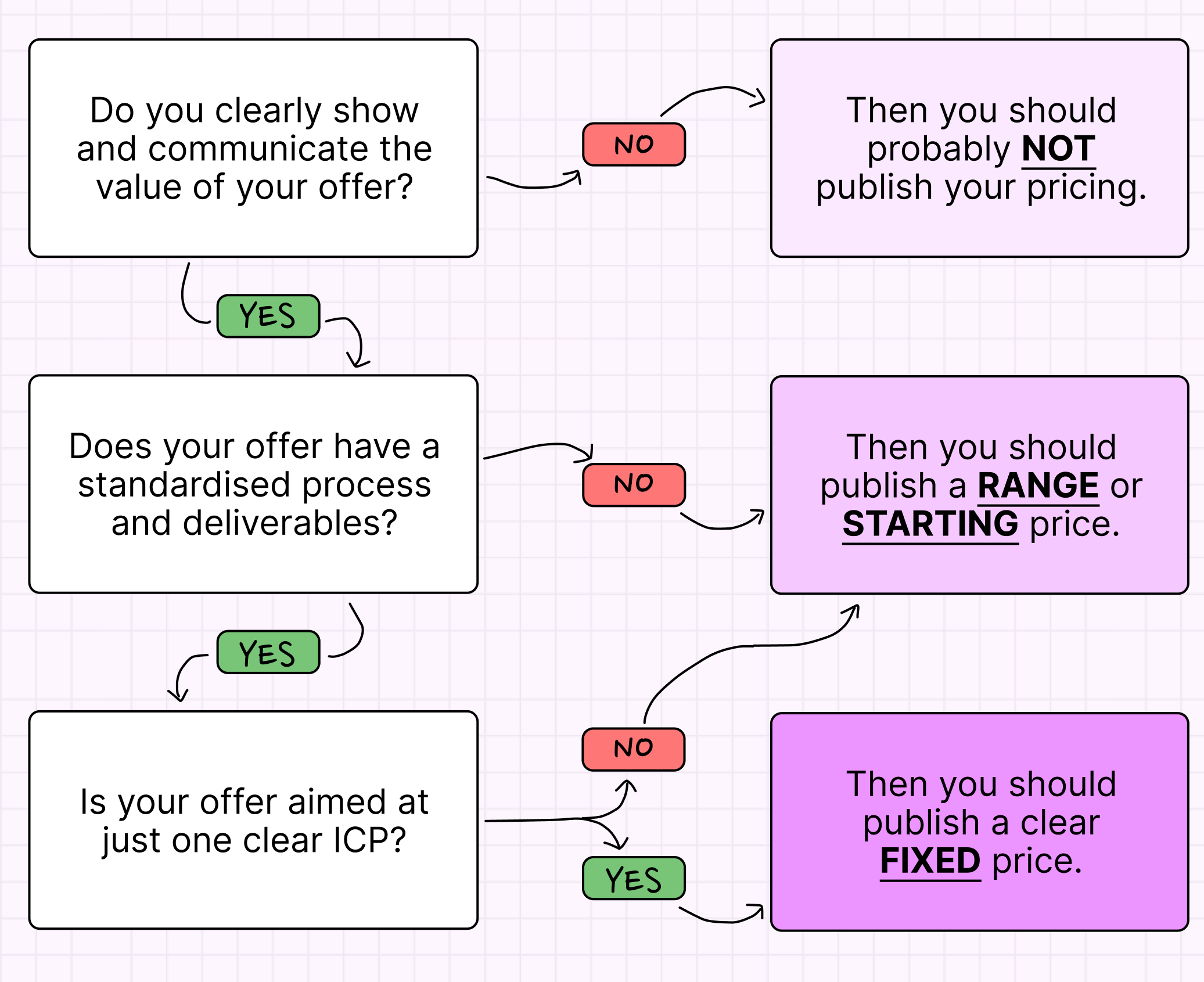
You have to clearly show the value of what you’re selling so that the price becomes justified in your buyer’s eyes.
You have to have standardised your offer as much as possible so that any changes are so minor that they barely impact the price.
And you have to focus on one clear target client so that budget is pretty much consistent across each prospect and the price therefore makes sense.
Here’s a handy flowchart to help you figure all this stuff out:
As always thanks for reading! If you have any pricing questions then I’m all ears.
Until next time,
Joe