

How to survive the AI-pocalypse.

I don’t know if you’ve heard, but there’s a terrifying monster looming on the horizon. A Godzilla-level threat to our very existence. Well, our jobs’ existence at least. That’s right. It’s AI. And it’s here for our careers. At least according to *checks notes* the very people who are set to make money if that outcome actually happens.
I mean, I’m just naturally a pretty sceptical guy, but I don’t think it takes a conspiracy nutjob to realise that there’s something at least a little fishy there.
It’s like someone knocking on your door saying “hey pal, there’s a strong wind coming and it’s probably going to blow your roof off, so you should pay us to reinforce it” and then you look down the road and the same roofing company are stood there with a massive fan blowing wind at people’s houses.
But hey, maybe I’m just a non-believer.
What I do believe is that AI is here to stay. Is it overhyped? Probably. Does that even matter when it comes to your consulting business? Possibly not. Here’s what I mean…
What AI can do doesn’t matter.
What people THINK it can do matters.
For example, whether sticking a stone egg into your vagina can or can’t give you more control over your hormones (it can’t) doesn’t matter. What matters is whether people think it can (they did) and that’s why Gwyneth Paltrow can literally forget movies she’s been in and actors she’s worked with. Because who cares when you’re selling stone vagina eggs for $65 a pop.

Now, clearly there’s at least a little more substance to AI. But the key thing to consider is the PERCEPTION of AI.
Because whilst you, a skilled expert in your field, might accurately surmise that AI can NOT replace you, that doesn’t actually matter if your target clients think it can. And this leads to a double frustration on your part.
First the financial hit when clients decide to DIY it with AI. And second the anger at how stupid they are for doing that in the first place.
So you see, even if you’re sceptical of AI taking over everyone’s jobs (like I am), that doesn’t actually matter. What matters is whether your prospects see it that way.
And unfortunately a lot of them don’t.
So what can you do?
The key lies in packaging your VALUE.
Not just packaging your services.
A lot of consultants I work with have usually tried to package up what they do. That’s great! But they often make the same mistake. They focus on what they do. They might take their services and put them in a box, give it a nice name, maybe even stick a price on there (woo price transparency!) and voila, you’ve got yourself a packaged-up offer.
Except you haven’t really.
Imagine you got a parcel delivered to you in a very plain boring cardboard box. A little confused, you open it to find a beautiful shiny smooth stone egg. But you know nothing of Goop. Of Gwyneth. Of vagina eggs. And so this feels like a very confusing thing to receive. You don’t see the point.
Now imagine you knew all about the value of vagina eggs and hormonal balance. And that cardboard box arrives. You rip it open to find the egg in all its glory. And it’s a matter of minutes before you’re sliding that up in there. (Is this the grossest sentence I’ve written in a newsletter? It might well be…)
My point is this: both of these packages are the same thing. But the way they’re framed is what makes one valuable compared to the other.
So it is with your offer.
Packaging up your services and focusing on WHAT YOU DO is a good start, for sure. But it’s not enough to make people interested. And not only that, but when you only talk about actions and deliverables, then you’re inviting a direct comparison with other ways of doing those things. Other ways such as… AI. That’s right. It’s all coming together now.
When you focus on what you do, prospects are more likely to compare you to AI.
“Oh you write blog posts? AI can do that.”
“Oh you design logos?” AI can do that.”
You see?
Which is why you need to package your value. In other words, focus on WHAT THEY GET, not what you do.
(Disclaimer: you need to do both ideally, but one is way more helpful when it comes to beating AI.)
You do that by focusing on the first two D’s of my Buyability Framework.
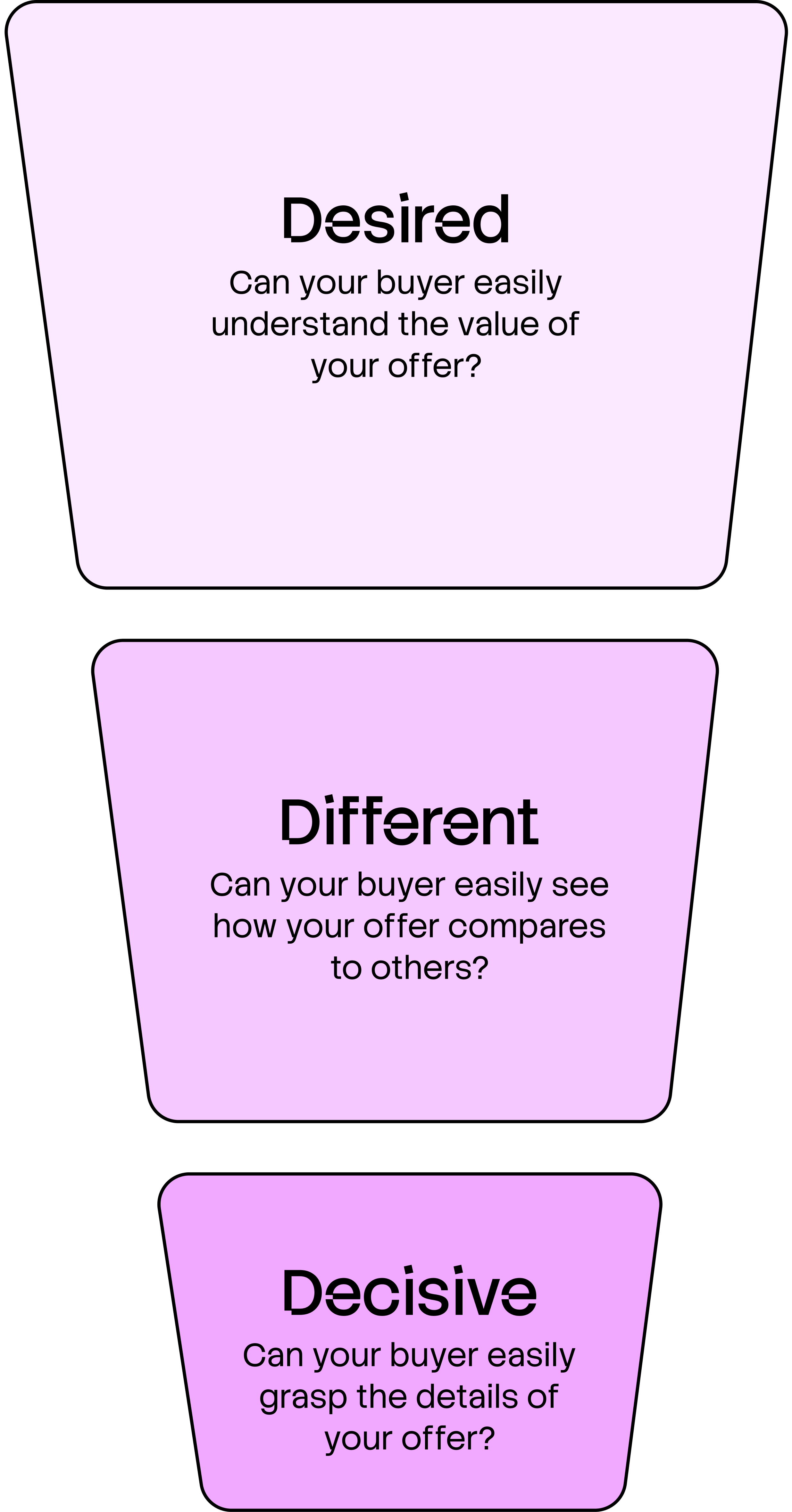
To make your offer more desired, you need to really hammer home the problem you’re solving for them, and the pains of not solving that problem.
To make your offer more different, you need to bring in your own IP or approach or perspective. Something that suggests you’re bringing a new way to the table.
And here’s why…
When someone is thinking about using AI, they’re already at the “solution-aware” stage. They know (or think they know) exactly what they need. And so they end up looking for the cheapest/fastest/easiest way of doing it.
And in that instance you have no chance against AI.
But if you focus further up the buyer journey - at the symptom-aware stage - then you’re talking to people who aren’t even sure what they need yet. And so they aren’t even thinking about how to do it with AI. They’re trying to figure out what the bloody hell they need.
That gives you a window of opportunity to get in ahead of AI, showcase your expertise, and become their go-to person for the problem you solve.
That’s how you survive the AI-pocalypse. Not by competing head to head against it, but by outflanking it and getting to people before it does.
Either that or crush it with a big hydraulic press, Terminator-style. Your choice.
Thanks for reading,
Joe
PS. If you’re still concerned about AI, why not book a power hour and discuss it with me. We can come up with a plan of action together.