

How to pick a problem prospects actually care about

Let’s talk about problems. Because one of the biggest problems I see with consulting offers is that they’ve picked the wrong problem to focus on. It turns out most of us a have a problem with picking a problem. And that’s a problem. Phew.
You see, as you’ve probably heard time and time again, B2B buyers aren’t just buying your services for the fun of that. They’re paying you to solve a problem.
And it turns out the consultant who best communicates the problem, is usually the one who ends up getting picked.
If you focus on what you do, without first explaining why it matters to them, then prospects are going to end up overlooking you.
I actually wrote about picking a problem a while back, but since then I’ve refined how I help the consultants I work with do this, and came up with a neat little framework.
I want to walk you through that, and the step-by-step sequence I recommend.
So without further ado…
The ACHE framework
Did I spend way too long making the acronym apt for what the framework’s about? Yes. Yes I did.
Was it worth it? I’ll let you be the judge.
ACHE is an acronym for four different criteria that I believe you should aim to meet with the problem you end up choosing.
They are:
Awareness
Cost
Hurry
Exclusivity
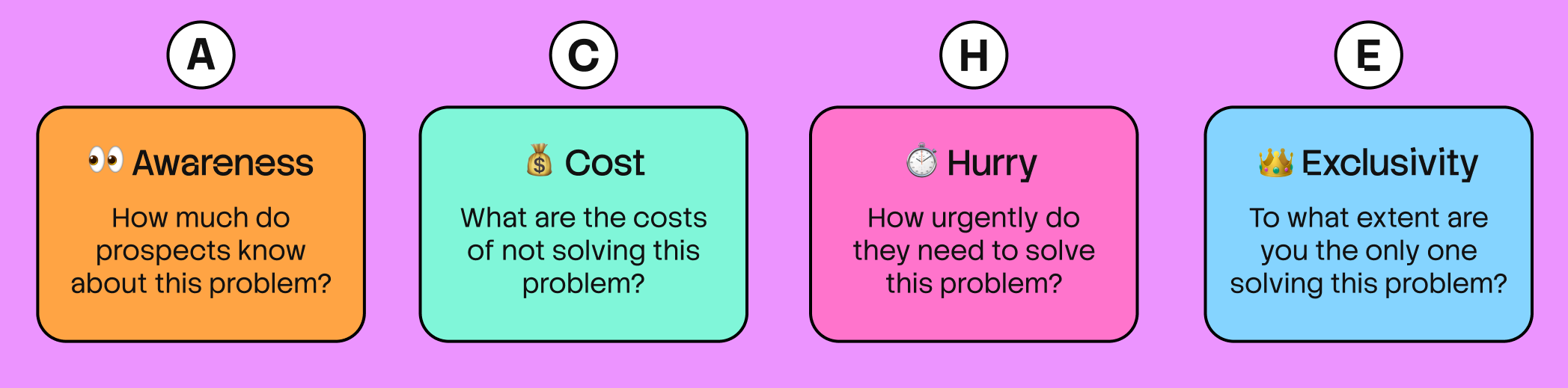
Let me explain each in a bit more detail.
Awareness
Your ideal clients should be problem-aware by the time they reach you. It sounds obvious, but if they aren’t actually aware they have a problem, then they aren’t ready to look for and buy a solution.
You don’t go to the doctor for some headache tablets if you don’t have a headache.
Now what I will say is that you can educate them about the problem through your marketing efforts. This is where content becomes key. I often encourage my clients to basically obsess over the problem in their content so that:
a) people start to realise they have the problem, and
b) they associate you with that problem
Which makes you the default choice to solve it.
When you pick a problem, it’s important to pick one that people actually know they have. This is how you meet them where they are.
If, for example, you decided to focus on the problem of “I’m struggling to get new customers”, then clearly that would score highly on awareness. Most people will be facing that struggle.
Cost
To be clear, this isn’t the cost of solving the problem, it’s the cost of NOT solving it. In other words, what happens if they don’t solve this problem? What are the stakes?
If the answer is “nothing much will change”, then the problem probably isn’t worth solving. And so the prospect’s willingness to spend any money, time, or effort on solving it will be low.
Consider this problem: “My site is slow to load”. You could argue that the costs of not fixing this are pretty low. It might be slightly annoying to users, it might impact search rankings slightly. But it probably isn’t too damaging. It’s not a priority.
And so a consultant leading with that as the core problem isn’t going to be very successful.
If, instead, you went with “Customers visit my site but they don’t book a call”, then you’ve now introduced a cost of not solving it. It becomes a much stronger problem statement, despite not being miles away from the slow-loading problem.
How you frame the problem is super important.
Hurry
This goes hand-in-hand with the cost criteria. Except this time it’s about, well, time. The most valuable problems also tend to be the most urgent. Because if a problem doesn’t need to be urgently solved, then it’s not a priority. And so your client’s budget ends up getting spent elsewhere.
There are two main ways to increase the urgency of the problem.
The first is to move further up the order of solutions. What I mean by this is that there's usually a natural order of problems to solve. For example, somebody might have a conversion issue on their website. But they might also have a lack of traffic problem. And getting the traffic is a larger priority because it needs to happen first.
So the further towards the root problem you can go (as long as it’s within your remit and expertise) the more urgent it becomes.
The other way is to introduce some time-based stakes. This could be based on an actual shift that’s coming. For example, a change in legislation or consumer behaviour. It could also be done by clearly outlining how that cost from the previous criteria is happening now, not something that might happen.
An example of this would be “You’re attracting prospects with your LinkedIn content but your profile isn’t making them take the next step”. See how that ramps up the time-pressure? It’s something you need to fix now or else you’re wasting your time with content.
Exclusivity
This is essentially the extent to which you’re the only one solving this problem. Chances are there will always be other solutions out there, but the rarer they are the better for you. It means less competition and a higher probability of owning the problem.
The best way to do this is to get specific.
If you said your chosen problem was “I’m struggling to get leads” then you can see how pretty much any marketing or sales consultant could conceivably claim this as the problem the solve. It’s so generic.
But if you got super specific and became the person to go to when “your Substack is getting read but not sending traffic to your site” then you become one of the only consultants focused on that specific problem.
Obviously you can go too specific, and essentially box yourself in. There’s a balance to be found. But generally speaking most consultants go too vague and top-level, so it probably won’t hurt to go a layer or too deeper and more specific.
How to actually use the ACHE framework
Okay so here’s a recap of the framework:
How do you actually use it?
If I were you, I’d follow these steps:
1 - Mine your previous clients for problems
This first step of “problem mining” is how you make sure any possible problems are based in reality. You do this by trawling through case studies, projects, work, sales calls, content that resonated, and basically everything you’ve done.
And you start pulling out any problems that clients came to you with, or that you helped solve, or even that they’ve simply referenced or spoken about.
This gives you a long-list of potential problems.
2 - Trim down to a problem shortlist
Ideally you want to cut your long-list down to the main three or four problems that you might end up choosing to focus on.
Often a lot of the problems on this list will be similar and overlap. You can consolidate these together. Sometimes you’ll have problems that you don’t really solve anymore and so are less relevant to where your business is heading. You can remove these.
And some of them you might just get a gut feel about. If a problem doesn’t really spark any kind of motivation or passion in you, then it’s probably a non-starter. You have to be a little obsessed about the problem you pick. Just not in a super crazy way.
3 - Score each problem across the ACHE criteria
Here’s where my framework comes in. You should now have three or four frontrunners to pick from. So let’s compare them.
Take each problem at a time and score them out of 10 for each of the four ACHE criteria. This will give you a total out of 40.
At this point there might be a clear winner, or maybe a couple that stand out. You can now start playing around to see if you can either improve them or even validate them with some prospects or clients.
Eventually you can pick one. And you’re done!
BONUS: Try out my interactive ACHE scorer
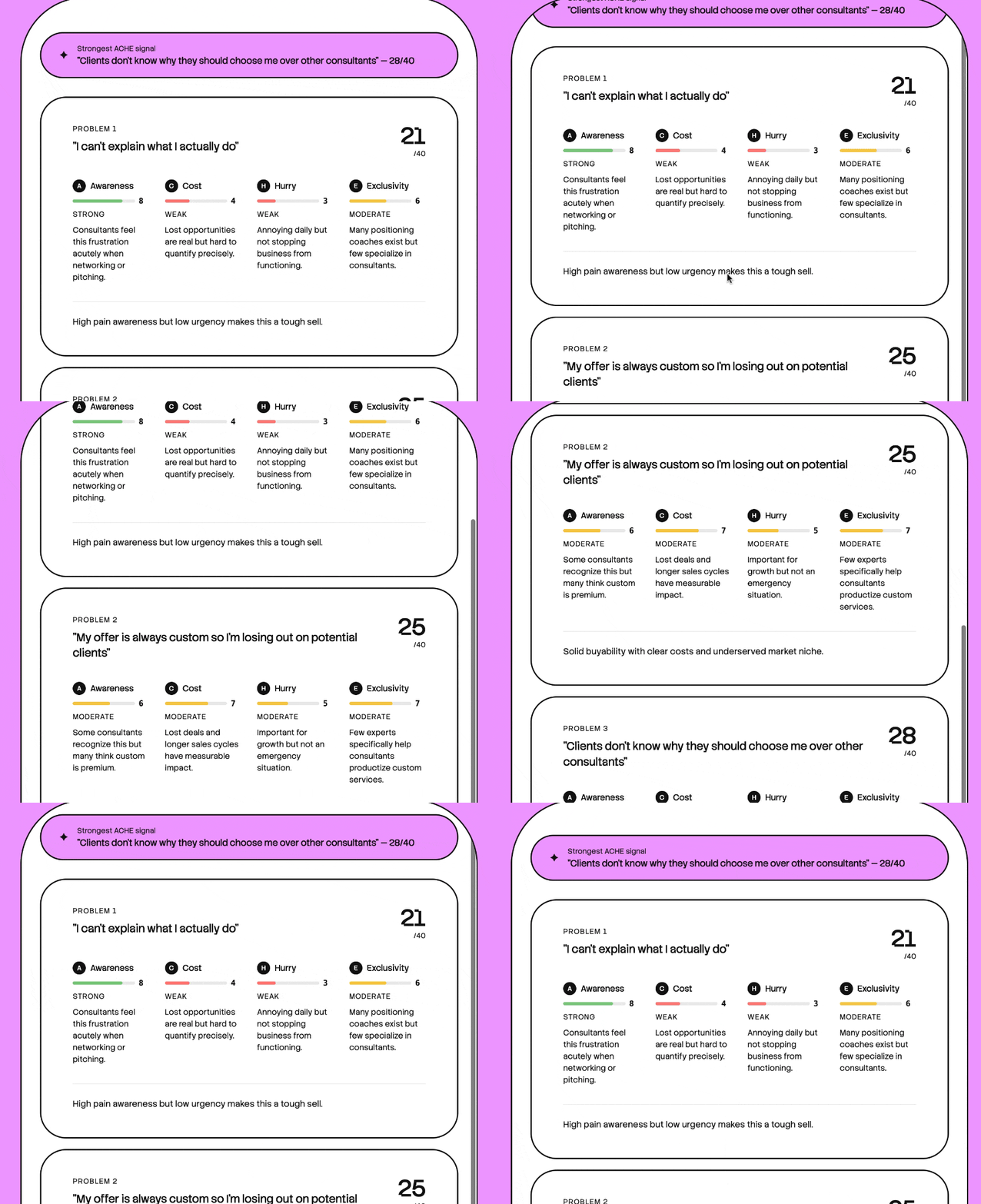
You can just try to objectively score each problem using my framework. But it can be hard to do this without being biased or assuming. My job when I do this with clients is to be the voice of the buyer and try to provide a more objective perspective.
But if you’re doing this on your own, you could give my ACHE scorer tool a try. You stick in up to three of your problem statements and it will score each one for you.
As always, thanks for reading. And happy problem picking.
Joe
PS. Don’t forget you can always request a free audit of your offer if you want my unbiased opinion on it. I don’t hold back though! Get it HERE.